
Before anyone asks me about grounds, before anyone asks about custody, before anyone asks who keeps the house, they ask me how long this is going to take. Every time. A person sits down across the conference table from me in Glen Burnie or dials in from Columbia, and somewhere in the first five minutes, out it comes. How long?
So let me answer it the way I answer it on the phone. There are two routes this can go, and which one you end up on decides almost everything else. It decides what you pay. It decides how much of the next year you spend thinking about this instead of living your life. And here is the part most people do not expect: you and your spouse pick the route, not the judge.
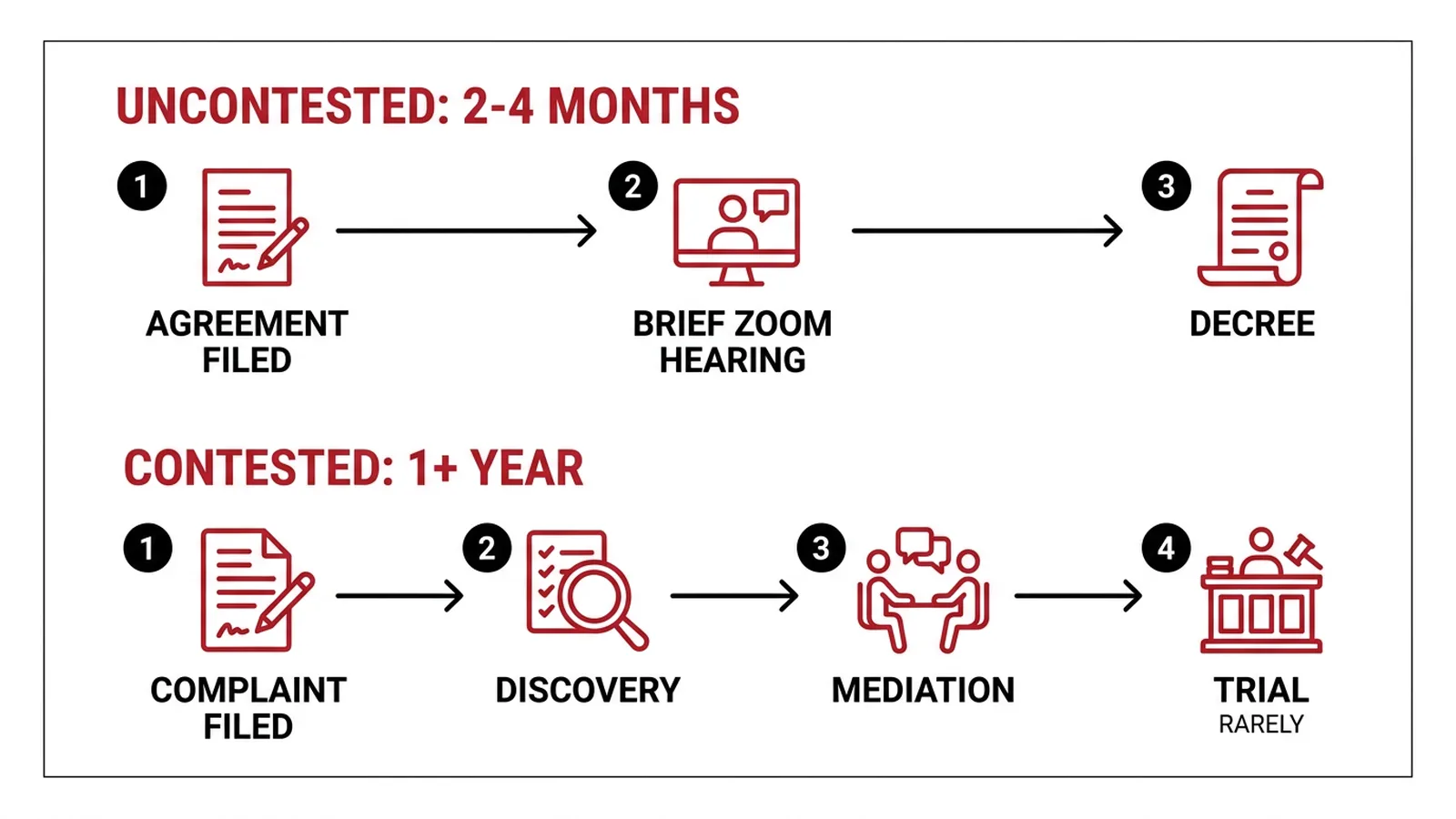
One route is called uncontested. That means you have a written agreement that resolves all the issues from A through Z. Not most of them. All of them. The other route is litigated, which means you could not get there, so a complaint gets filed and a court starts running the case. I would say if you have the agreement, you are looking at two to four months. If you do not, you are looking at a year, and often longer than that.
That gap is not a small thing. It is the difference between a spring and a summer, and the difference between a legal bill you can absorb and one you feel for years.
If they have an uncontested divorce, which means that they have a MSA or a marital separation agreement, which means that they've come up with answers for all of the questions, pretty much from divorce and custody all the way down to counsel fees, then they can submit what's called an uncontested divorce request, meaning that because the agreement resolves everything, that they're done. I would say if they do it that way, then they're looking at two to four months, depending on how quickly the paperwork passes.
The two-to-four-month track
The document that puts you on this track is a marital separation agreement. Lawyers call it an MSA, and it is exactly what it sounds like: a written agreement, signed by both of you and preferably notarized, that answers every question your marriage leaves open.
I want to be precise about what every means, because this is where people get tripped up. It runs from what I would consider the first issue, which is custody and divorce, all the way to the last issue, which is attorney's fees. Custody, the house and the retirement accounts, child support and alimony, and the counsel fees at the end of it all have to be answered in writing. An agreement that settles four of those things and leaves the fifth for later is not most of the way to an uncontested divorce. It is a contested case with some progress in it.
Once that agreement exists, the rest of it is close to administrative. You submit what is called an uncontested divorce request, and there is a hearing, but it is not a trial and it does not feel like one. It is usually a Zoom hearing, about ten minutes long, held to take the testimony a judge needs to grant the divorce. Then your agreement becomes part of the judicial divorce and you are done.
Two to four months, depending on how quickly the paperwork passes. Notice what that timeline turns on. Not a courtroom, and not a judge's calendar, but the paperwork, which is the whole reason the number stays as small as it does.
The year-or-longer track
Now the other road. If a complaint for divorce or custody gets filed and the two of you do not agree on the big issues, meaning divorce, custody, property and retirement, then you are headed for trial, at least on paper.
For a case like that, I would say a minimum of a year to a year and three or four months. Put custody in the middle of it and the number gets worse, because once you are into court evaluators and expert witnesses, you are talking at least a year, if not more, and a very significant sum of money along with it.
The part I want you to sit with, though, is the strangest fact about this whole system. I still think about ninety-eight percent of these cases settle before their actual court date.
Read that again. The long road is usually not the road to a trial at all. It is the long, expensive road to the same kind of agreement the other track reaches in two to four months. Most contested cases end in a signed agreement; they just spend a year and a great deal of money getting there.
Sometimes that year is unavoidable, because one side genuinely will not move and there is nothing you or your lawyer can do about it. But if you are on the contested track over a single open issue that both of you could probably live with settling, you are buying a year of your life and a much larger bill to arrive somewhere you could have reached by spring.
The courthouse adds months you did not cause
Part of that year has nothing to do with you, your spouse, or anything either of you is arguing about. It is the docket.
The two courts I spend the most time in are Anne Arundel County Circuit Court and Howard County Circuit Court. Both of them right now are so overloaded that when you look for a court date, you are looking for a court date months and months down the road. That is the line every estimate in this chapter sits on top of. You could resolve every real issue in your case by month four and still be sitting in month ten waiting for a trial slot that nobody needs anymore.
Family cases absorb that delay so badly for a structural reason, and it is worth understanding. In criminal cases there is a requirement that a trial occur within a certain period of time, unless the defendant agrees that there needs to be more time. That rule pushes criminal cases to the front of a crowded calendar. Nothing like it exists for a contested divorce or custody complaint. There is no clock forcing your case forward. So it waits behind every case that has one.
I am not telling you this to make you feel stuck. I am telling you because it changes what a settlement is actually worth. When you are weighing whether to keep negotiating or let a judge decide, you are not choosing between an agreement now and a ruling in a few months. You are choosing between an agreement now and a ruling after a wait you do not control.
What it costs, and the number that is not in dollars
Time is the first question. Money is the second one, and it arrives about thirty seconds later.
One of the good things in Maryland law is that if the parties can come to an agreement, they can save themselves a huge amount of emotional stress and a huge amount of money by doing what is called an MSA or a consent order. Read that sentence for what it lists first. Emotional stress comes before money, and that is not a courtesy. In these cases it is usually the larger number.
On the money side, the difference between the two tracks is not a percentage. An uncontested case is a handful of filings and a short hearing. A contested case carries discovery, expert witnesses and evaluators, and then the courtroom time on top, plus every hour your lawyer spends answering the other side's version of all of it. Those are not the same kind of bill.
Lawyers who do this work have a joke about how a good domestic settlement looks. Things went well if neither party was satisfied. It sounds cynical the first time you hear it. It is not. It means both of you gave in enough to make it work, and when there are children involved, that is so important. Nobody walks out of a family case with everything they asked for. The question is whether you spent a year and a great deal of money to find that out, or four months.
Why the fork happens before you ever call a lawyer
Here is what I want you to take away from this chapter. The decision that sets your timeline usually gets made before anyone hires anybody.
The case does not get moving until someone files and then someone gets served. That is how the litigation process begins. But the choice about which track you are on was made earlier than that, in kitchen conversations, in what each of you decided you were willing to talk about. And on the custody piece especially, I have a firm opinion about which way that choice should go.
The more the parties agree to, in my personal opinion and the opinion of most judges, the more the parties agree specifically regarding custody issues, the better off the situation is for their children. The reason is not complicated, and it is not a legal argument at all. No judge who meets your kids through testimony in two or three days is ever going to know your kids the way the parents do.
That is the whole case for agreement, in one line. A contested custody trial hands the most important decision in your child's life to someone who is meeting that child through two days of adult testimony and a stack of papers. You already know the child. You know the bedtime, the teacher, the thing that upsets them, the friend who matters. Every issue you resolve yourselves is an issue decided by the two people in the room who actually have that information.
So when you ask me how long a Maryland divorce takes, understand what you are actually asking. You are asking how much you and your spouse are prepared to settle between yourselves. That answer, more than any court calendar, sets your number.
Common questions
How long does an uncontested divorce take in Maryland?
Two to four months from filing to a signed decree, as long as you have a complete marital separation agreement covering divorce, custody, property, and counsel fees. The case usually closes with a short Zoom hearing, about ten minutes, to take the testimony a judge needs to finalize the agreement. The timeline depends on how quickly the paperwork passes, not on a trial date.
How long does a contested Maryland divorce take?
A minimum of a year to a year and three or four months, and longer once custody brings in court evaluators and expert witnesses. Most contested cases still settle before their actual court date, so the long timeline is usually the expensive road to an agreement rather than the road to a trial.
Does a Maryland divorce require living in separate homes first?
Not under every ground. The legislature changed the law so you can seek a divorce while you are still living together. I am not telling you that makes it easier. Living under the same roof while a case is pending is hard, and "in some areas I think it makes it much more difficult," not less. But you can legally file.
Why does a contested case take a year when most of them settle anyway?
Two reasons stack up. Contested cases run through discovery, evaluators, and expert witnesses, all of which take real time. Then the docket adds its own delay, because Anne Arundel and Howard County are both booked months and months out. Criminal trials have a statutory deadline pushing them forward. Family cases do not, so they wait.
Chapter reflection
The timeline question sounds like scheduling. It is not. It is a choice, and most families make it without ever noticing they made it.
Settle everything, and you have chosen two to four months. Leave one major issue open, and you have chosen a year and a bigger bill and a wait nobody in the case controls, most likely to arrive at an agreement in the end anyway. That is the trade, laid out plainly, and it is worth understanding before you are standing in the middle of it.
The next chapter goes back one step further, to the three grounds Maryland recognizes for ending a marriage, because which ground you file under is the first visible sign of which track you are already on. My Glen Burnie and Columbia teams each keep their own walk-through of that first step online: the firm's Glen Burnie divorce team and the Columbia office's divorce page.