
The chart in the last chapter is the easy half. The hard half is the number you put into it.
Start from the right default, because people generally start from the wrong one. Pretty much everything that is income counts toward income. There is very little that does not count, and most things do count. If your instinct is to ask whether some particular payment is excluded, the honest answer is usually no.
Two categories are where this actually gets difficult, and around here they cover a great many of the families I see. Military pay, because part of it is an allowance that moves when you move. And self-employment income, because the number your tax return shows and the number Maryland counts are not the same number.
The long list of things that count
For someone working for a company or a business, the reach is broad. Overtime counts. Any type of incentive plan counts, and when I say incentive plan, I mean any kind of plan for a commission or a bonus. All of that is included.
It goes past your paycheck too. It also includes things like disability pay and SSDI, which is Social Security insurance for people who are deemed by the government to be disabled. So if you were assuming a disability payment sits outside this because it is not employment, it does not.
There is one category I am deliberately not going to reduce to a rule here, and I want to be straight with you about why. Stock is a little different. I did not get into it on the show and I am not going to pretend a paragraph settles it. If a meaningful part of what you are paid comes in equity, raise it directly with your own lawyer rather than assuming it gets treated the same way a cash bonus does.
Everything else, assume it counts until somebody with your actual documents in front of them tells you otherwise.
Military pay, and the allowance that moves when you do
For the Fort Meade and NSA families in my practice, this is where the number moves fast.
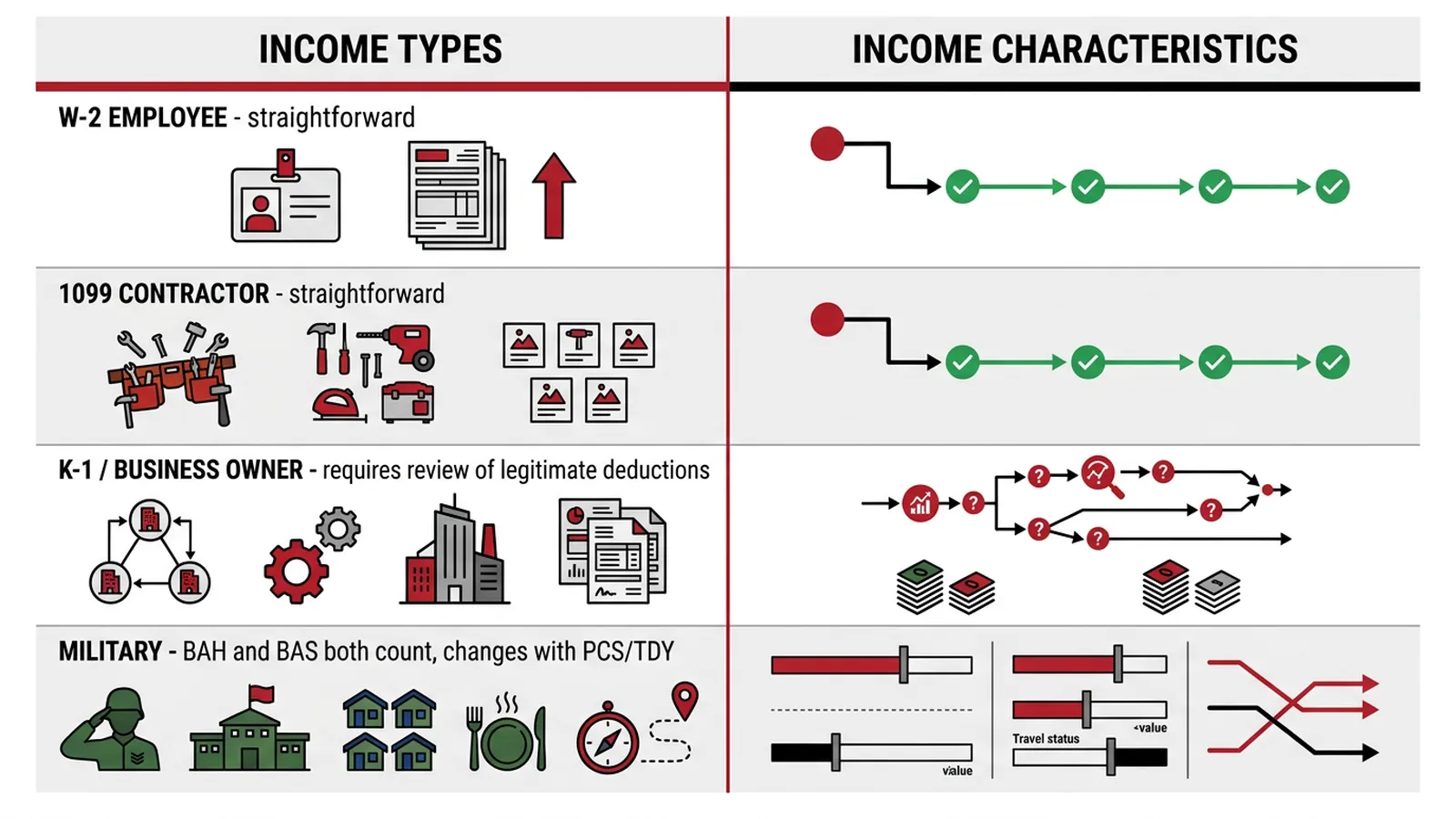
What's really important in this area, because Fort Meade and NSA and all these military installments are around here, is BAH, which is locality pay for the military, is very high here. So for example, the guy I had this morning lived in Anne Arundel County, and his BAH pay was like $3,300. That's what the military assigns as a number, and that number counts as income as well.
Thirty-three hundred a month. That is a big number if you moved here to be in the military, and it goes into the guidelines the same as salary does. BAS counts too. All of those payments count toward your number in child support, and people who are not in the military do not have those numbers at all.
Now here is the part that surprises service members, and it works in both directions. BAH is locality pay, so it moves with your duty station.
I had a client whose case was exactly this. He was moving from here to Fort Gordon, Georgia, and because he is moving to rural Georgia, his BAH is probably going to drop by half. Same person, same rank, same job. Half the housing allowance, because Georgia is not Anne Arundel County.
So a TDY or a PCS, which are the two ways that you transfer locations in the military, can affect your child support amount. If you are about to move, that is not a detail to raise after the order is signed. It is a reason to be in front of a lawyer before it happens.
One more thing while we are here, because it comes up in the same conversation every time. The military is also affected by things like pensions and TSPs, and the reason is that divorce is a state thing, not a federal thing. The rules of Maryland are what matter, not the federal rules.
Self-employment, where the tax return is the starting point and not the answer
If you own your business, you do not have a simple salary to point at, and this is the category where the number can move the most depending on how carefully somebody looks.
If you are a self-owned business, the legitimate income, meaning the net income of the business, most of the time includes some kind of salary if it is a corporation. That salary counts. But if your lawyer is good, your lawyer is going to go through the tax return and look at everything there is to look at.
Why? Because a lot of the discounts that are available to the federal government are not available in child support law. Those are two different systems with two different purposes, and a deduction the IRS blesses is not automatically a deduction Maryland accepts.
The example I always reach for is this one: "if you have a vehicle that's a delivery vehicle and you're using that to go on vacations with, the part of the time that you're on vacation does not count for child support, and that gets really complicated. But the short version is, for self-employed people, it's their legitimate deductions that remove money from their income, not taxable income."
That distinction is written into the statute itself. Under Md. Code, Family Law § 12-201, the "ordinary and necessary expenses" a business can subtract from its gross receipts for child support purposes specifically exclude accelerated depreciation, investment tax credits, and any other business expense a court finds inappropriate for calculating actual income, even where the IRS allows the identical deduction on a federal tax return.
The paperwork that proves it, and when you cannot do this alone
Everything above has to be proven with documents, and that is what discovery does here. Discovery is the process by which the attorney attempts to get all of the information that he or she believes is relevant to the issue of child support.
How hard that is depends entirely on how you are paid. If you have a W-2 or a 1099 employee, that is relatively simple, and a W-2 employee is the simplest case there is. One form, one number, done.
Businesses are a different animal. When you get into a business that is what is called a flow-through business, which means the business does not pay taxes or get refunds, it is based on the owner's or the various owners' income, and they pay or get a refund. That makes things complicated. In addition to a W-2, those types of earners also get what is called a K-1, depending on the type of corporation. A K-1 is how the federal government figures out what income expenses can be reduced from the income of the business, in a way that reflects directly on the owner or the various owners.
So W-2s and 1099s make things easy. Business owners and corporations are a lot more difficult to deal with.
And this is the one place in this whole book where I will use the word requirement about hiring somebody. Any time there is an issue of expenses being deducted for tax return purposes and the person owns their business, it is an absolute requirement for the person who is seeking child support to get themselves a lawyer, myself included, or to get themselves a lawyer who understands how this stuff works. There are lots of different kinds of businesses, and some of them are extremely tricky, and it would not be my recommendation for someone to do that without the help of a lawyer.
If you are on the other side of a business owner in a support case and you are handling it yourself, understand what that means. The number you are being handed came off a document nobody neutral has examined.
Common questions
Does military housing allowance count as income for Maryland child support?
Yes. BAH is locality pay, and in this area it is very high, so it is a big number in the guidelines. BAS counts as well, and all of those payments count toward your number in child support. Because BAH tracks your duty station, a TDY or a PCS transfer can change your support amount meaningfully in either direction.
How is self-employment income calculated for Maryland child support?
Through the legitimate income of the business, meaning its net income, often on a K-1 alongside any W-2 salary. A lot of the discounts available to the federal government are not available in child support law. For self-employed people, it is their legitimate deductions that remove money from their income, not taxable income.
Do bonuses and commissions count toward Maryland child support?
Yes. Overtime counts, and any type of incentive plan counts, meaning any kind of plan for a commission or a bonus. Disability pay and SSDI count too. There is very little that does not count and most things do count, so your working assumption for any payment should be that it is in until someone tells you otherwise.
What about stock or equity compensation?
Stock is a little different, and I am not going to give you a rule for it here, because it is not something that reduces to one. If a meaningful part of your pay arrives as equity, take it to your own lawyer with the documents rather than assuming it is treated the way a cash bonus is.
Do I need a lawyer if the other parent owns a business?
In my view, yes. Anytime expenses are being deducted for tax return purposes and the person owns their business, it is an absolute requirement for the person seeking child support to get a lawyer who understands how this works. Some of these businesses are extremely tricky, and I would not recommend anyone taking that on alone.
Chapter reflection
Almost everything counts, and the two exceptions to that simplicity are the two situations most common around here. An allowance that changes with a duty station, and a tax return that was written for a different purpose than the one a family court is using it for.
Both of them reward looking carefully and punish assuming. A parent who accepts the other side's income figure because it came off an official-looking form is accepting a number nobody checked.
And income is still only half of the formula. The other half is time, counted in overnights, and it moves the final figure just as hard as a change in income does. That is next.