
Divorce is usually the easy one. By the time you come to see me, you are usually in a place where you have, for the most part, already been separated, and that makes it much easier. The marriage itself is often the part both of you have already accepted.
Custody is different, and it is different in a way that catches people off guard. If you agree upon custody, that is a big deal, because there are two different types of custody in Maryland. Two separate decisions, each governing a different part of your child's life, and you can settle one of them completely and still be a year away from settling the other.
So before you tell anybody you agree on custody, make sure you know which one you are agreeing about.
The standard behind both decisions
Both halves get decided under the same legal test, which is the best interests of the child. That phrase sounds abstract until you see what a court is actually weighing.
It is pretty much common sense stuff. Who spends the most time with the child. Who knows the doctors and who knows the friends. Who helps with the extracurriculars, who puts the kids to bed, who cooks for them. That kind of thing. All of that stuff is important, and there is a bunch of case law defining it, but the list itself is not mysterious.
Look at what is not on that list. Not one of those factors turns on which parent is the mother and which is the father.
I am spelling that out because of an assumption that walks through my door more than almost any other, and it is not true. I have heard men cannot get custody in Maryland. Fathers tell me this before we have discussed a single fact about their own case, and it shapes how they approach the entire process, sometimes to the point of not fighting for something they would have gotten. Maryland's custody standard does not distinguish by gender. Both physical and legal custody are decided on the same best-interests factors, no matter which parent is asking.
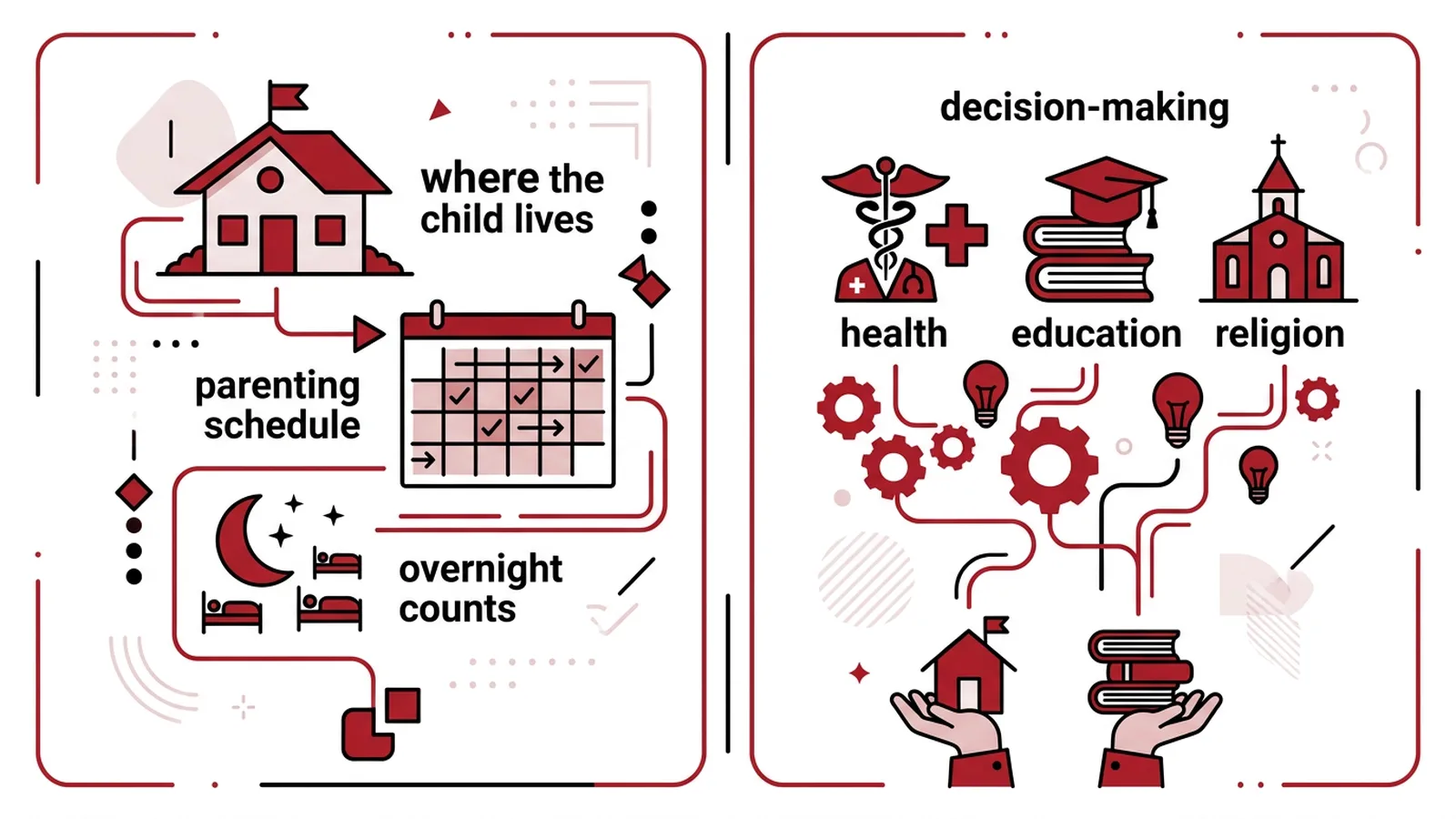
If they agree upon custody, that's a big deal because there's two different types of custody in Maryland. There's physical custody, which is where the child or children actually reside and what time, how many days a week, that kind of thing. But then there's what I believe is equally important, which is what's called legal custody, and legal custody is decision-making about what they call the kid's health, education, or welfare.
Physical custody decides where your child sleeps
Physical custody is the intuitive half. It is where your child or children actually reside, and what time, how many days a week, that kind of thing.
This is what almost everyone means when they say the word custody at all. It is your calendar. Who has them Tuesday, who has them on the long weekend, where the backpack lives.
Hold on to one thing about this half as you keep reading, because it comes back in a big way later in this book. Physical custody is counted in overnights, and overnights are what drive your child support number. When you negotiate the schedule, you are also negotiating the money, whether or not anyone in the room says so out loud.
Legal custody decides who gets to decide
Legal custody is the half that causes the sharpest fights, and it causes them precisely because it is invisible day to day. You will not see it on your calendar.
Legal custody is decision-making about what they call the kid's health, education, or welfare. In my experience the fights land on a specific handful of issues. Most of the time it deals with adult issues such as religion and medical care, "those type of things where the parties really do care about those couple things. Those seem to be the things where the largest standoffs occur."
The trap in it is easy to miss. If your child is with you five nights a week, you will reasonably assume the decisions come with the nights. They do not. Physical custody and legal custody are separate awards. You can have the child most of the time and still need the other parent's agreement on a school, a surgery, or a religious upbringing, and you can hold joint legal custody while the child sleeps somewhere else most nights.
That is why I call legal custody equally important. A schedule you dislike is a hard year. A decision-making deadlock over medical care is a hard decade.
Use and possession of the family home
Custody carries a direct consequence for the house, and it has its own part of the statute.
Under Md. Code, Family Law § 8-206, a court may award a parent with custody of a minor child the exclusive use and possession of the family home. That holds no matter how the property itself is finally divided. The purpose is what the statute itself states: letting a child continue living in an environment and community familiar to them, rather than uprooting a household in the middle of an already disruptive process.
The name for it is use and possession, and use and possession is complicated, but it is part of Maryland's family law statute and family law article. What it says is that a parent who is awarded custody has the ability to remain in the home for up to three years from the date of the divorce.
The specific limit lives in Family Law § 8-210. It caps a use-and-possession order at three years from the date the court grants the annulment or divorce. It cuts the order off sooner if the parent holding possession remarries inside that window. A court weighs the child's best interests, each party's own need for the home, and any hardship the arrangement creates for the party excluded from it before granting or shaping such an order.
And it does not have to be all or nothing. That authority isn't limited to handing the home to one parent outright, either. Under Family Law § 8-208, a court can instead divide possession and use of the family home between both parties, rather than award it exclusively to one. That is the basis for the arrangements where the parents rotate through the same house on a schedule instead of either one moving out.
Plan for the end of the three years now, not in three years
Because a contested divorce can run a year or more, it is tempting to file the three-year clock under problems for later. Something that only starts counting once all of this is finally behind you. I do not think that is the right way to handle it.
As I put it on the show, "as we've already discussed, the divorce could take a really long time. So pretty much the unspoken rule is it's three years of separation regardless of when that was." The clock does not politely wait for your case to end.
What I do not want you doing is "waiting until the case gets to the place where everyone's sort of done and then saying, 'Okay, let's do this all over again,'" because that is a second fight you are scheduling for yourself. Build the answer into the settlement itself. Say what happens when the order expires, who buys whom out, or when the house goes on the market, and write it down while both of you are already at the table with lawyers in the room.
Doing that work now "gives you an opportunity to look it in the face right now," instead of being surprised by it three years after the decree is signed, when you are out of practice at negotiating with this person and the goodwill is gone.
Common questions
What is the difference between physical and legal custody in Maryland?
Physical custody is where the child or children actually reside, and what time, how many days a week. Legal custody is decision-making about the kid's health, education or welfare. Maryland treats them as two separate questions. Either one can be awarded jointly, solely or in a split arrangement, which is how two parents agree on custody and still spend a year fighting about it.
Can one parent stay in the family home after a Maryland divorce?
Often, yes. A parent who is awarded custody has the ability to remain in the home for up to three years from the date of the divorce, under a use and possession order. The court looks at your child's best interests, each party's need for the home, and the hardship on the party who is shut out of it.
Which type of custody is harder to agree on, physical or legal?
In my experience, legal custody produces the bigger standoffs. The fights land on adult issues like religion and medical care, the couple of things where both parties genuinely do care, rather than on a calendar. A schedule can be traded away. A deadlock over your child's medical care usually cannot be.
Is it true that fathers cannot get custody in Maryland?
No, and I hear it constantly. Fathers tell me they have heard men cannot get custody here before we have discussed one fact of their case. Maryland decides both physical and legal custody on the same best-interests factors no matter which parent is asking, and none of those factors is about gender.
Does having my child most nights mean I make the decisions?
No. Those are the two different types of custody, and they are awarded separately. You can have physical custody most of the week and still need the other parent's agreement on health, education or religious questions, because that authority sits in legal custody and has to be awarded on its own.
Chapter reflection
The two-custody structure is the single most useful thing in this chapter, because it explains a conversation that otherwise makes no sense. Two parents say they agree on custody, and six months later they are still in court. They were agreeing about different halves.
Sort out which half you actually agree on, and you will know very quickly whether your case belongs on the two-to-four-month track or the other one.
What happens next is where most contested cases genuinely end, and it is not a courtroom. It is a mediation session and a stack of financial documents. Both of my offices keep a fuller walk-through of the custody piece than one chapter can hold, at Glen Burnie child custody page and Columbia child custody page.