
The Maryland Child Support Formula, from Guidelines to Final Number
The first thing to understand about child support in Maryland is that a judge is not picking your number out of the air.
The guidelines are established by the legislature. They are a list, and that list lives in what is called the Family Law Article, which is the set of statutes in Maryland that control family law. So when someone tells you their support number felt arbitrary, what they usually mean is that nobody explained where it came from. It came from a chart, and the chart came from Annapolis.
The short answer is that it is the legislature's list of how much parties are to pay for child support if they are going through a divorce or a custody case. This chapter is about how that list works, where it stops, and what happens past the end of it.
The guidelines are established by the legislature... they're a list that are included in what's called the Family Law Article of Maryland. The Family Law Article is a statute, which is a rule that explains, based on parties' joint income, so both of the parents' incomes, what child support is.
How the chart works, and where it stops
Two things go into the chart. Your combined income, and how many children you have.
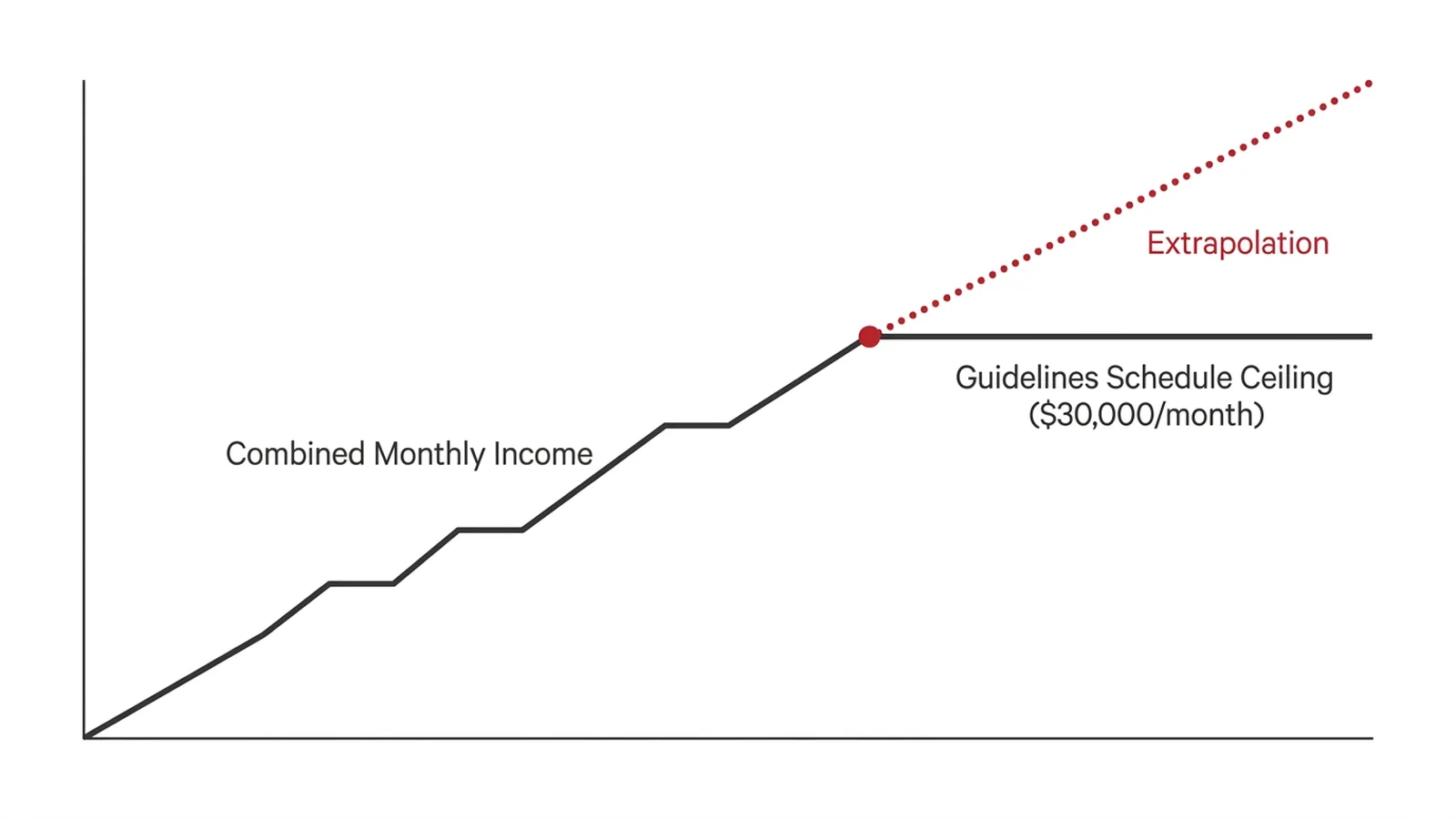
Under Md. Code, Family Law § 12-204, Maryland's Child Support Guidelines set a schedule of basic support duties. The schedule runs on both parents' combined gross income and the number of children. It goes up to a combined income of $30,000 per month. The schedule itself is a grid, not a single line. It runs a separate column for one child all the way through six or more. So the same combined income produces a different basic obligation depending on how many children that income has to support.
Now, one detail here trips people up when they compare notes with a friend, so let me be plain about which number that chart runs on. The child support goes up to about thirty thousand per couple. That is the figure the two of you make together, because everyone's combined income is what it is based on.
Then there is the word that matters more than any of this, and it is gross. As I put it on the show: "the party's gross income, and that's really important. It's gross income for child support. For things like alimony, it's net income."
Do not gloss over that, because it is the single most common miscalculation I see someone walk in holding. Gross income means the income a party receives before taxes. If you worked from your pay stub, using the number that actually hit your account, your figure is wrong, and it is wrong in a direction that will surprise you.
Each party shows what their income is, and then the Maryland guidelines will say, based on this joint income, this is the amount that the party who is not the primary custodian has to pay for the children. Whatever you make is calculated from the lowest to the highest. It is just after that $30,000 there can be an extrapolation.
The statute's own term for that number is adjusted actual income, not raw gross income. Certain adjustments apply before either parent's figure goes through the schedule. The most common are alimony a party already pays, or other children they already support.
A chart that sat still for twenty-five years
Here is something worth knowing before you compare your number against anything you remember.
There was a change several years ago. Before that, there had not been a change in the guidelines for something like twenty or twenty-five years.
Sit with that. The schedule I run in court today is a meaningfully updated version of one that did not move for two and a half decades. So an old printout, a stale page you found online, or a friend's memory of what they paid can be quietly wrong, and nothing about either parent's income has to have changed for it to be wrong.
If your reference point for what child support costs in Maryland is somebody else's case from a while back, throw it out and start from the current chart.
Above the ceiling, where a judge finally gets a say
Everything so far has been arithmetic. Past $30,000 a month in combined income, it stops being arithmetic.
The only time that a judge's opinion is important in child support is if they are over the max. If the parties' joint income is over $30,000, then there is the opportunity for the court to issue a higher number, and that is called an extrapolation. An extrapolation means that for people who have over $30,000 a month in income, the court can award more than the guidelines.
This is not rare in either of my markets, and it is common enough in one of them to matter. Howard County happens to have a very significant amount of significant aggressive earners, so that amount changes.
What is the court actually deciding up there? Not an abstract question about what a child theoretically needs. If it goes to trial, the court looks at the evidence about what the expenses are for the kid to live his life the way he has been living it, to the best of their ability, and they have the right to extrapolate, or add as much child support as they believe is appropriate based on the child remaining where he is and also in his best interests.
The standard is continuity. What has this child's life cost so far, and what does it take to keep it roughly the same.
There is also a tool in the room. There is a program called SassyCalc that all the lawyers and the judges own, and it does an automatic extrapolation for you. Useful to know, and worth not overreading. SassyCalc automates a computation. It does not decide what your child's life costs, and that is the part that gets argued.
Why the free calculator gives you the wrong number
A lot of parents have already run the free calculator before they ever call me, and I understand exactly why you would. It is free and it is right there.
Lots of attorneys have connections on their websites to potential guidelines, but the only guideline that is publicly available is the one from what is called the Department of Human Services, which is the department part of the Office of Child Support Enforcement. It does give you rough numbers. But I am not confident, first of all, in their technology, and second of all, it does not necessarily explain to the parties exactly what things have to be at.
That second half is the real problem. There are things like daycare and health insurance and medical issues that all need to be included, and a calculator that does not tell you which of your numbers goes where will happily produce a confident total from the wrong inputs. I guess if the person who was doing it was very knowledgeable, it could be done. But I do not think the majority of people doing it on their own would have the ability to understand how to calculate the guidelines.
And I will tell you what this looks like from my side of it. I have been doing it for 30 years, and I did it in court this morning, and it is a little bit of a process.
If it is still a process for someone who has run this calculation for three decades and ran one before lunch today, do not expect a free tool and twenty minutes the night before a hearing to hold up when the other side's lawyer looks at it.
Common questions
How does Maryland calculate child support?
From a schedule the legislature set, based on both parents' combined gross income and the number of children, running up to a combined income of $30,000 per month. Each parent shows their income, the chart produces the basic obligation, and the parent who is not the primary custodian pays their share. Above that ceiling the court can extrapolate.
Should I trust an online Maryland child support calculator?
Treat it as a rough number only. The publicly available one comes from the Department of Human Services, part of the Office of Child Support Enforcement, and I am not confident in their technology, and it does not explain to you exactly what things have to be at. Daycare, health insurance and medical issues all have to be in there correctly.
Is child support based on gross or net income in Maryland?
Gross income, before taxes, and getting that right matters more than almost anything else you do here. Child support runs on gross. Alimony is the one that uses net income. If you built your estimate from your take-home pay, your number is wrong, and correcting it usually moves your figure by more than you expect.
What happens if our combined income is over $30,000 a month?
You are past the end of the chart, and that is the one place a judge's opinion actually matters. The court can extrapolate and award more than the guidelines, based on evidence of what the expenses are for the child to live his life the way he has been living it. Lawyers and judges run those numbers through a program called SassyCalc.
Chapter reflection
A chart, a ceiling, and one place where a judge gets to weigh in. That is the architecture, and knowing it is the difference between accepting a number and understanding one.
But a chart is only as good as what you put into it, and that is where this gets genuinely difficult. The input is each parent's income, and income is rarely one clean line on one pay stub, especially around here.
If you are military, part of your pay is an allowance and it moves when you move. If you own a business, the number your tax return reports and the number Maryland counts are not the same number. That is the next chapter. My child support pages for Glen Burnie and Columbia go further into that starting point.