
My Glen Burnie office sits close enough to Fort George G. Meade and the National Security Agency that this is not a specialty I went looking for. It walked in, and if you are reading this chapter, you are probably why.
I am pretty experienced in this area, because I would say a good forty percent of my practice is people who are either at Fort Meade or NSA or those kind of places, who have either been in the military actively or were in the military and now do consulting work, which is big for post-military folks. That is a big deal for how you should read this chapter. If you serve, or your spouse does, this is not a footnote about an unusual client. It is your whole case.
So here is what actually changes when one of you serves, and what does not.
The rules stay the same, except for one thing
Start with the reassuring part. The rules pretty much remain the same, except for one important thing.
That one thing is this. If a spouse files against someone in the military, that person has the right to be protected in the rare event that they have been deployed, or that they are somewhere their commanding officer can write a letter to the court saying my client is not able to be here because they are in a war zone.
That protection exists because of the obvious unfairness it prevents. Without it, your spouse could file, serve you while you are physically in Afghanistan, wait out the thirty-day answer window from Chapter 3, and take a default judgment against you while you have no way to answer it. The statute exists so that cannot happen to you.
I would say that the military is an area where I feel very comfortable with knowing what you have to do to properly represent someone that's serving in the military. I also serve on Anne Arundel County's SCRA board, which is the board that is designed to make sure that if someone is in the military and a divorce or a custody case is filed against them, that they have counsel which is appointed by United States statute to make sure that they are not going to lose out on a custody case or a divorce case if they are in fact deployed.
What happens when the court appoints someone like me
Here is the mechanism, and I am inside it, so I can tell you exactly how it runs.
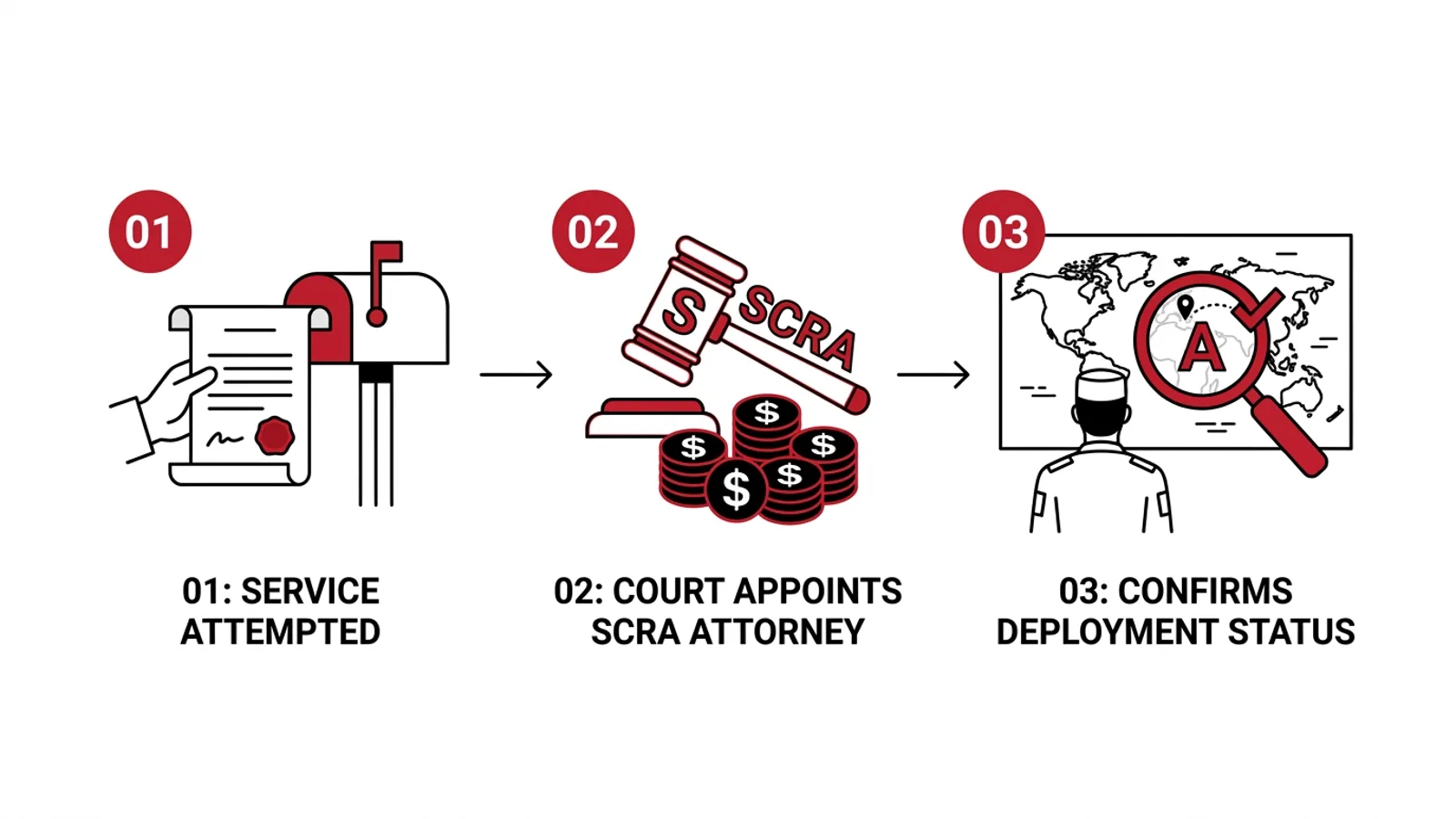
Anne Arundel County keeps a panel of attorneys who volunteer for this work, and I am on it. If a party is allegedly served and that party is in the military, then under the SCRA, which is a federal act, they are appointed an attorney by the court. The non-military party must pay for that attorney. It is only $500.
Once the court appoints me, my job has two questions in it. Number one, do they live around here, and could they get to court if necessary? Number two, which is actually more important, are they deployed? And if they are deployed, are they deployed in a place that would stop them from being able to receive a divorce?
Notice what I am not doing there. I am not defending the case, and I am not arguing about your custody. I am establishing whether you can participate at all, and that answer is what the whole protection turns on.
The federal statute goes further than the appointment, and if you are the one deployed, these are the protections you have. Before a court can even consider entering judgment against someone who might be a servicemember, the plaintiff first has to file an affidavit addressing that party's military status. If the defendant turns out to be in the military, the court can't rule until counsel is appointed.
Beyond the appointment itself, the statute lets a servicemember or their appointed attorney ask the court to pause the case entirely. It directs a stay of proceedings of at least 90 days where the servicemember's own presence might be needed to raise a defense, or where counsel simply can't reach them yet. The protection survives even a judgment already entered.
Say a default judgment is entered against a servicemember during their service, or within 60 days after it ends. If their service materially affected their ability to defend the case, the statute lets them ask the court to reopen it. Provided they can show they actually had a defense to raise. The full text is at 50 U.S.C. §§ 3901 et seq.
Maryland law controls, not federal law
This is the misconception I correct most often, and if you have done your homework, you are more likely to hold it, not less.
A lot of guys come in here from the military, and women too, and think they know everything because they have looked at the statutes for the federal government. But the federal government does not decide your case. Maryland does.
If you are at Fort Meade or if you are at NSA, then Maryland law controls, not federal law. That is a difficult issue for a lot of people who are active in the military and think they have an understanding of how divorce and custody law works, because it is not the federal government that just gets to decide that, or even decide retirement. It is Maryland state law that figures that out.
Divorce is a state thing. It is not a federal thing. That reaches further than most people expect, because it covers the things a service member is most protective of. Pensions. TSPs. The retirement you have been building for twenty years. The rules of Maryland are what matter in the case of a divorce, not the federal rules, and reading a DoD regulation very carefully will not change that.
Federal law does draw the outer lines around military retired pay. The Uniformed Services Former Spouses' Protection Act, 10 U.S.C. § 1408, is what allows a Maryland court to treat that pay as marital property at all, and for divorces since late 2016 it fixes the divisible amount at the service member's pay grade and years of service as of the divorce. Maryland decides how the pay is split. Federal law decides how much of it is on the table.
The SCRA protects your right to participate in the case. It does not move the case, or the law it is decided under, anywhere else.
Dividing the retirement, and the Bangs formula
Retirement is where the federal-versus-state point stops being abstract and starts costing you money.
The courts use a formula for things like retirement. It is called the Bangs formula, B-A-N-G-S. To make a long story short, it compares the time you were married while you were earning that retirement against the whole time you have been earning it, and that fraction is how the court figures out who gets what when it comes to that.
Two things commonly come out of the pile before that formula runs against you. If a party has what is called a premarital interest, which means it is something that they acquired before the marriage and have not put marital funds into, that gets separated out. So does an inheritance or a gift you received. Those matters would be separated out of the pile when it came time to figuring out assets and who gets what.
That second half is worth a sentence of its own, because of the condition buried in it. A premarital asset stays premarital only if you have not put marital funds into it. The house you owned before the marriage, that you then refinanced and paid down with joint income for nine years, is not the clean carve-out people assume it is.
The gap Maryland has not closed
Now the part that bothers me, and that I am actively working on.
Maryland's custody standard is in the best interests of the child, and it applies to you the same way whether or not you wear a uniform. Modification of custody in Maryland can only happen when there is a significant change of circumstances or a material change of circumstances. Deployment, by itself, is not automatically treated as one.
I had a case on exactly that. My client was deploying from Fort Meade here to Fort Gordon, Georgia, and it ended up that he got custody. But that was only because he and his wife separated back in 2022 and he has been the primary caretaker. He won on the facts he already had, not because Maryland law gave a deploying parent anything.
What is so interesting to me is that there are currently 17 states in the United States that have legislation specific to the rights of a party who gets deployed.
Seventeen states have legislation in place that specifically not only does not allow a modification based on a deployment but also gives the wife or husband and family of the person that's deployed the opportunity to spend the same time with the children as the person who's deployed is, but Maryland does not have that legislation.
There is one state that I am not positive about, but I believe it is Pennsylvania, that also has that legislation pending. Maryland does not have that kind of law. What Maryland does have is narrower. Family Law § 9-108 requires any custody or visitation order entered during a deployment to say so on its face, gives a parent who files within 30 days of coming home an expedited hearing, and requires any order based on a deployment to make the other parent accommodate the deployed parent's leave and make room for phone and email contact with the child. It does not stop a deployment from being used to change custody, and it does not let the deployed parent's family step into that parenting time, so every single case of deployment in Maryland is still a different set of facts.
Let me show you what that gap costs, because I have a case in Howard County Circuit Court right now that puts it in front of you.
My client is the father. He works at the APL lab and is also in the reserves, and over the last year or two he was pulled from the reserves into basically the desert. He served for ten months across Israel, Afghanistan and Egypt. His divorce had been final for several years already. Because of what was happening at the time, and because of his representation at the time, which I do not think was top-tier representation, he had agreed for his ex-wife to move to Missouri and raise their child there. He and that child are very close.
The mom decided that while he was away, she was going to play games with his ability to be a parent. He testified that for the ten months he was in the Middle East, he was allowed to call one time a week, on Sunday. We put in records to show that for those weeks, he called every Sunday, and every single call from him to his ex-wife's phone for their little kid was canceled.
Ten straight months, and he did not speak to his child once. It broke his heart without question.
I have asked that judge, in that county, to give him custody, the same way I asked for the guy in San Antonio. That decision was going on a Zoom record the day after we recorded this, so I was hopeful for it.
Whatever any one judge decides, the point stands. It is hard for me to imagine that any judge, or anybody who cares about children, could ever think that a dad who is in the desert living in a war zone does not get to talk to his kid. Seventeen states wrote that down. Maryland has not.
Common questions
Does military deployment stop a Maryland divorce?
Not automatically, but a deployed party has the right to be protected from being defaulted while they cannot appear. Under the SCRA the court appoints an attorney, paid for by the non-military party, whose job is to find out whether that person could get to court and whether their deployment location would stop them from receiving a divorce at all.
Does federal law or Maryland law control a divorce involving a Fort Meade service member?
Maryland law controls. If you are at Fort Meade or NSA, Maryland law decides it, not federal law, and that covers how retirement is split too. Federal law, through the Uniformed Services Former Spouses' Protection Act, sets the limits on how much military retired pay can be divided. The federal act protects your right to participate in the case. It does not move the divorce, the custody question, or the pension division out of Maryland.
How is a military pension divided in a Maryland divorce?
Through the Bangs formula, which compares the time you were married while earning the pension against the whole time you have been earning it, and that fraction is how the court figures out who gets what. A premarital interest, or an inheritance or gift, usually comes out of the pile first, as long as no marital funds went into it.
Does Maryland protect a deployed parent's custody time the way some other states do?
Not in the same way. Seventeen states have legislation that blocks a deployment from being used as a basis for modification and lets the deployed parent's own family take that parenting time. Maryland does not. Its deployment statute, Family Law § 9-108, is narrower: an order entered during a deployment must say so, a returning parent who files within 30 days gets an expedited hearing, and an order based on a deployment must protect the deployed parent's leave and phone and email contact. Beyond that, every deployment case here is decided on its own facts under the ordinary material-change standard.
Chapter reflection
The federal layer in a military divorce is narrower than most service members expect. It protects your ability to show up, and it caps how much military retired pay can be divided. It does not decide custody or how your property is split, and it does not move your case out of a Maryland courtroom.
What that leaves is an uncomfortable truth if you are the one deploying. The protection you get is the protection you build into your own facts, in a custody arrangement written while you can still be heard, because Maryland's own deployment statute stops well short of what those seventeen states wrote.
Which brings the next chapter into focus. Custody in Maryland is not one decision. It is two, and the one families fight hardest over is usually not the one they came in worried about. If you are a military family still working through the SCRA or the Bangs formula, my team has more detail at Glen Burnie military divorce page or Columbia military divorce page.