
Income is half the formula. This is the other half, and it is simpler to state and stranger in how it behaves.
The way it works pursuant to Maryland law is that child support is based exclusively on overnights. Not on hours. Not on who does the school run or who sits through the orthodontist appointments. Overnights, counted out of a year.
Out of 365 of them, there is one number that changes everything, and where your schedule sits relative to that number matters more than almost any other fact in your case. It catches my clients by surprise on a regular basis, usually at the worst possible moment, which is after the schedule is already agreed.
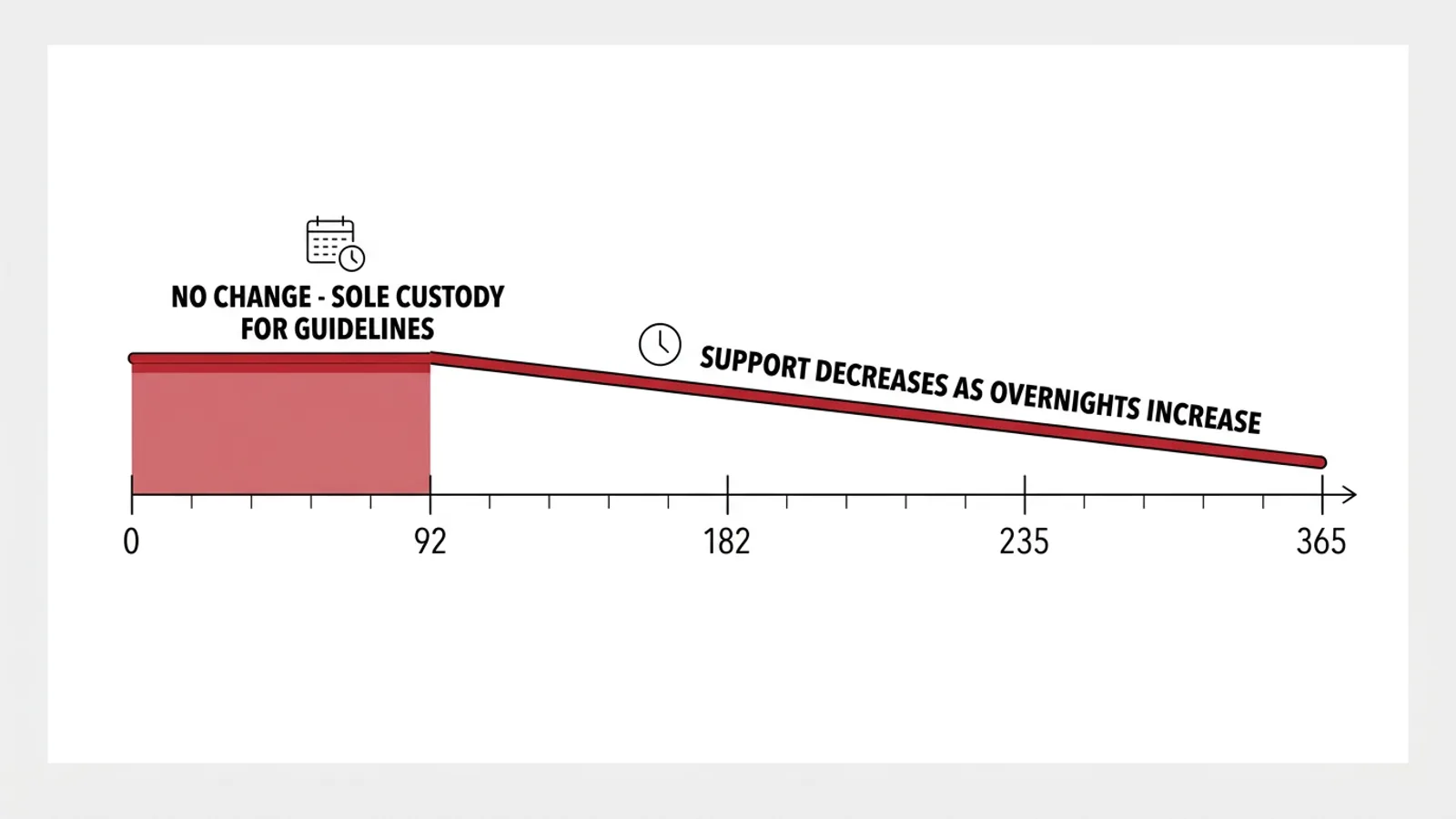
In Maryland, the big issue is this: out of 365 overnights, from zero to 92 overnights, nothing changes because that's what's considered sole custody for child support guidelines only. However, from 92 to 365, the more overnights a party has, the less they pay.
Zero to ninety-two, where nothing you do moves the number
Start with the flat stretch, because it is the counterintuitive one.
From zero to 92 overnights, your number does not change. So if you had two overnights or 92 overnights, it would be the same. That whole range is what is considered sole custody for child support guidelines only.
Read that last part carefully, because the phrase does real work. Sole custody for child support guidelines only. It is a calculation category, not a statement about your relationship with your child and not what a custody order says about you as a parent.
Still, look at what it means in practice. A parent with two overnights a year and a parent with ninety-two, which is roughly every weekend, pay exactly the same amount. All that additional time, and the number does not move at all.
Ninety-two to 365, where every night counts
Cross ninety-two and the behavior flips completely. From 92 overnights to 365 overnights, that number changes dramatically based on the amount of time.
And the direction is consistent. The more overnights a party has, the less they pay. As I put it on the show, "depending on the income, obviously, someone who had 92 overnights is gonna pay significantly more than someone who has 250 overnights, because from 92 to 250 every time it'll be a reduction."
This is the fact I most want a parent negotiating a schedule to be holding. Your custody negotiation and your support negotiation are the same negotiation. They happen in the same room, on the same day, usually without anyone saying so out loud. Every overnight you trade away above ninety-two is money, and every overnight you take on is money as well.
I am not telling you to negotiate a schedule for the money. I am telling you not to negotiate one without knowing the money is moving, because a parent who gives up a weeknight to avoid an argument in mediation has made a financial decision and may not realize it for another year.
One narrow exception exists, and I will give it to you because it is real, but do not plan around it. For most people in normal nine-to-five jobs, it is pretty standard for overnights to count. But if a parent worked a night shift and was not able to sleep at the same time as the children but was still there with the children all the time, that would still count. Unless your situation is genuinely unusual in that way, the count is the count.
The add-ons, and why you have to prove them
Health insurance, daycare and exceptional medical expenses all go on top of the base guidelines number. None of them is automatic, and each one has to be proven.
Health insurance first, and I am going to tell you plainly what it is worth. You need to get what is called a rate sheet, which shows the different types of insurance the business offers and what each one costs. The court lets you take the expense for whether it is a family or one child, whatever the listing is for your party, and subtract from it the number it would be for just the parent. Whatever is left goes in as a reduction in income for health insurance.
Now the part nobody advertises. "It is not a big change, and unless the health insurance number is huge, it is not that helpful." It does give the person who is providing the insurance a little bit of a benefit. If you were counting on the health insurance credit to move your number meaningfully, adjust that expectation now.
Medical is the next one. If there are what they call exceptional medical circumstances, for example kids that have more permanent health issues requiring care, whether it is medical care or psychological care, those would be included in the guidelines.
And the last thing, which is probably the most normal and used thing, is daycare. That one is a big deal, and it is where the real dollars usually are.
Daycare, the summer problem, and what a real case looks like
Daycare has a trap in it that catches people who do the math in good faith and still get it wrong.
Most of the time, the daycare during the school part of the year is not as significant, because the kids are not there full time. But then in the summertime it jumps. A lot of times it doubles, or even sometimes triples.
The method is the one I use in every one of these: "what you need to do, or really what a lawyer should do, is average out the total of the nine months of school time and what that costs for daycare and the three months of summer and what that costs." That gets all put together, you come up with a monthly average, and the monthly average for daycare is included in the support guidelines. Submit your September number instead and you are understating your own cost by a lot.
Here is one from my own docket so you can see the size of it. There were four kids in that case, but two were older and did not need daycare, so two did. As I described it: "so that number was, let's say, $1,500 a month for two kids, which is actually really inexpensive."
Then the split. Whatever the ratio of income for the two parties is, is how the money is split. So if it is a 50/50 arrangement and the parties are each making the same amount of money, then when the $1,500 went into the guidelines, $750 would go on each side. That amount is based again on the ratio of income, so it moves if the incomes are not even.
Notice that $1,500 did not quietly disappear into the base support figure. It got split, on the record, according to what each parent earns. Whichever parent pays for the insurance or the daycare directly gets the credit in the guidelines, and the other parent pays their share based on their percentage of income out of a hundred percent.
How long the order runs
One more thing parents ask once the number is settled: how long am I paying this.
The court order, according to the legislature, is that child support is valid until you are 18, unless you are in high school, and then it ends at 19. So if it is your 18th birthday and you are still in high school, then it does not end until either school ends or your 19th birthday, whichever comes first.
The court's own power runs to the same endpoint. The court has jurisdiction from the time the court order is in place until the child turns 19 for child support purposes. Within that window it can change the order. After it, the court can no longer change the order or set new support. But any support that went unpaid before then is still owed, and the court can still enforce it.
Common questions
How many overnights change a Maryland child support calculation?
Ninety-two is the line. From zero to 92 overnights your number does not change at all, because that whole range counts as sole custody for child support guidelines only. Two overnights and ninety-two produce the same figure. Above 92, the number changes dramatically, and the more overnights you have, the less you pay, all the way up to 365.
Does a 50/50 custody schedule mean no child support is owed?
Not necessarily. An even overnight split is one input, and income is the other. Support is still calculated from each parent's income relative to the other, then adjusted for the overnight count. Add-ons like daycare are split by the same income ratio, so an even schedule with uneven incomes still produces a payment.
How is daycare factored into Maryland child support?
Average the nine months of school-year cost against the three months of summer, when it often doubles or even triples, and use that monthly average. It goes into the guidelines, the parent who pays it gets the credit, and the other parent covers their share based on their percentage of the combined income.
How long does a Maryland child support order last?
Until the child turns 18, unless they are still in high school, in which case it runs until school ends or their 19th birthday, whichever comes first. So an 18th birthday during senior year does not end it. The court can modify the order right up until that endpoint. Support that went unpaid before then is still owed afterward, and it can still be enforced.
Does the health insurance credit make much difference?
Usually not much. You get it by producing a rate sheet and subtracting the parent-only rate from the family or one-child rate, and the difference goes in as a reduction. But it is not a big change, and unless the health insurance number is huge, it is not that helpful. It gives the parent providing coverage a little benefit.
Chapter reflection
Two numbers produce your support figure. What each of you earns, and how many nights your child sleeps at your house. One threshold inside the second number, at ninety-two overnights, decides whether more time with your child changes anything financially at all.
Knowing where your schedule sits against that line before you agree to it is worth more than any argument you can make afterward.
But neither number is permanent. Jobs end, incomes move, and occasionally a parent arranges for their income to move at a convenient moment. Maryland has rules for all three of those, and they are not the same rules.