
A ground is the legal reason you give the court for ending your marriage. You have to pick one to file, and you now have three to pick from.
Maryland eliminated its fault-based divorce grounds in 2023. The state now recognizes three no-fault grounds under the Family Law Article: mutual consent, six-month separation, and irreconcilable differences.
Most people walk in assuming this part is a formality, a box you check on page one. It is not. Each ground asks you for something different before you are allowed to use it, and picking the wrong one can cost you months you did not have to spend. I have watched people wait out a separation period they were never required to serve, because they were working from what a divorce looked like in Maryland fifteen years ago.
So let me take them one at a time, and tell you what each one actually demands from you.
Mutual consent, where the wait is zero and the price is a complete agreement
Mutual consent is the fastest ground on the books. It is fast because of what it asks for up front, not because of any clock that runs shorter.
Under Md. Code, Family Law § 7-103, a mutual consent divorce requires a written settlement agreement signed by both parties. That agreement has to resolve alimony, property, and the care, custody, and support of any minor children. A completed child support guidelines worksheet goes with it where one applies. There's no minimum separation period attached to this ground at all.
That is the same A-to-Z agreement I described in the last chapter, the one that answers every question pretty much from divorce and custody all the way down to counsel fees. Once you have it, you file the uncontested request and the case is short.
The statute builds in two safeguards on top of that agreement. Either party can still file to set the agreement aside before the hearing, which keeps a case from finalizing over an objection raised at the last minute. And even with a complete agreement in hand, a judge isn't simply rubber-stamping it. The court still has to independently find that whatever your agreement provides for the children serves their best interests before signing off.
That last one is not a formality. A judge who reads your custody schedule and does not like it can say so.
Maryland has changed its grounds from divorce from a number of different ones to one called irreconcilable differences, which means that now even if you live, and this is super important, even if you live in the same home, you can still seek a divorce from your spouse.
Six-month separation, and what living apart has to mean
A lot of Maryland residents remember a waiting period and assume it applies to everything. The waiting period still exists. It just belongs to one specific ground now: living separate and apart, without interruption, for six months before you file.
This is the distinction people get backwards most often, so let me be blunt about it. If you have a complete signed agreement, you gain nothing by sitting out six months first. Mutual consent is open to you today. The six-month clock is for the couple who have been apart but have not finished agreeing on everything.
Then there is the name of the ground, which makes it sound like it requires two mailing addresses and two rent payments. The statute is narrower than the name.
Under Family Law § 7-103(b), the court treats parties who are pursuing separate lives as living separate and apart even if they still occupy the same home. That holds even where a court order is the reason the arrangement exists. In practice, that means a couple who has genuinely stopped functioning as a married couple, no shared finances, no shared bedroom, no shared routine, can satisfy the six-month clock without either spouse moving out.
You do have to be able to show a judge later that the separation was real, and not a fiction staged for the filing.
That matters more than it sounds. Running two households in Anne Arundel or Howard County is expensive, and for a lot of families, a required year apart was not a legal inconvenience. It was the reason they stayed married.
Irreconcilable differences, the ground with no wait and no agreement required
The third ground, irreconcilable differences, lets you seek a divorce based on reasons you state to the court for the marriage's permanent breakdown. No six-month separation requirement, no complete settlement agreement in hand required. It's the ground for a couple whose marriage is over but who have neither reached full agreement nor lived apart for six months yet.
This one changed something practical that a lot of Anne Arundel and Howard County couples still do not know: even if you live in the same home, you can still seek a divorce from your spouse. None of the three current grounds requires proof that you physically separated.
Unlike the fault-based grounds Maryland eliminated, proving irreconcilable differences doesn't call for evidence of misconduct by either spouse. You state the reasons the marriage has permanently broken down, and the court isn't adjudicating who caused that breakdown, only whether it genuinely happened.
What the old law required, and why the change is a big deal
The current structure feels ordinary now. It replaced something considerably harder.
Maryland before that used to have a policy and legislation where you had to be physically separated for a year, which means you could not reside in the same house as your spouse, and you could not have sexual relations with them for a year before you could file. A full year. Two roofs, two sets of bills, no exceptions, before either of you was allowed to walk into the courthouse and ask.
That standard was not just slow. For a lot of the families I sat across from, it was unworkable, because they could not afford to run two households for a year to buy the right to file. So they stayed. Shortening the clock and dropping the residency requirement did not make getting a divorce easy, and I would not tell you it did. What it did was make access to the legal system much better for people who could not buy their way to the courthouse door.
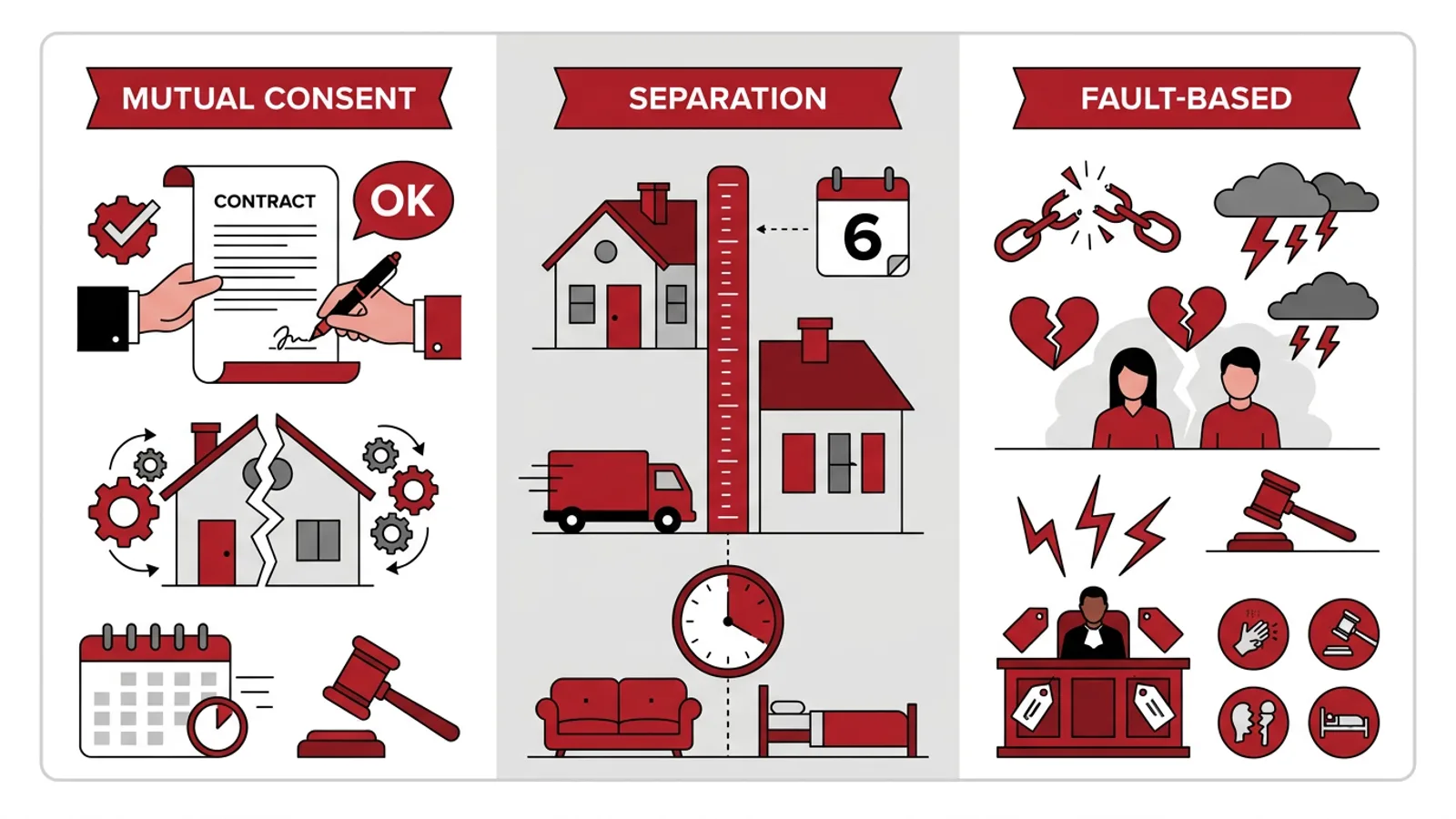
Picking the wrong ground costs you months
Basically, these three are not interchangeable, and the wrong pick has a real price.
Have a signed, complete agreement? File on mutual consent now. Waiting out a six-month separation first buys you nothing at all. Been separated six months but still fighting over custody or the house? Mutual consent is not available to you, so you are filing under the separation ground or irreconcilable differences, depending on your facts.
And here is the advice that does not change no matter which of the three you land on. Unless you have a completely uncontested divorce, meaning the only thing you literally have to do is say you do not live together anymore and that you were married, I do not recommend anybody, contested or uncontested, doing this without a lawyer if it is affordable to them. If it is not affordable, that is a different conversation, and there are agencies out there that help litigants who do not have lawyers. But do not confuse a simple-sounding ground with a simple case.
Common questions
What are the three grounds for divorce in Maryland?
Mutual consent, six-month separation, and irreconcilable differences, all under Family Law § 7-103. Mutual consent requires a complete written agreement but no waiting period. Six-month separation requires living apart without interruption for six months. Irreconcilable differences require neither, as long as you state the reasons the marriage has permanently broken down.
Do you have to live apart before filing for divorce in Maryland?
Not under every ground. Mutual consent and irreconcilable differences both let you file with no separation period at all, including while you are still sharing a home. Only the six-month separation ground requires time living apart. The legislature changed this, and it is a big deal for anyone who cannot afford two households.
Can you get divorced in Maryland without a lawyer?
I do not recommend it for anyone whose case is not completely uncontested, and I mean that for contested and uncontested cases alike, if hiring one is affordable to you. If it is not affordable, there are agencies out there that will help litigants who do not have lawyers. What I would not do is skip the question because the ground sounds simple.
Does it matter which ground I file under if I am going to settle anyway?
It matters for your timeline. Mutual consent runs on the agreement alone, so a couple who have settled everything can file immediately instead of waiting out six months they never owed. Choose a ground that does not fit your facts and you either wait unnecessarily or file something you cannot support.
Chapter reflection
Which ground your case files under is usually the first honest signal of where it is headed. Mutual consent means the hard work is already behind you. The other two mean at least one question is still open, and that open question is what the next several chapters are about.
But before any of that, there is a mechanical step that trips up more first-time filers than any ground ever has, and it is the one nobody thinks to ask about. Which courthouse actually has your case.